What makes a good proposal?
It should be accurate, clear, and include the right price. But that is hardly enough. It also needs to address the customer’s needs, reflect how the company does business, and make the next step easy to understand. Sometimes it needs to explain a complex arrangement. Sometimes the most important thing is to keep it short.
An experienced employee makes many of these judgments without giving them much conscious thought. They know the business, understand the customer, and have a feel for what usually works.
But what happens when an AI agent is asked to put together the proposal?
That knowledge needs to become something we can communicate. What used to live in an employee’s head needs to be expressed in a way that allows someone else to act on it.
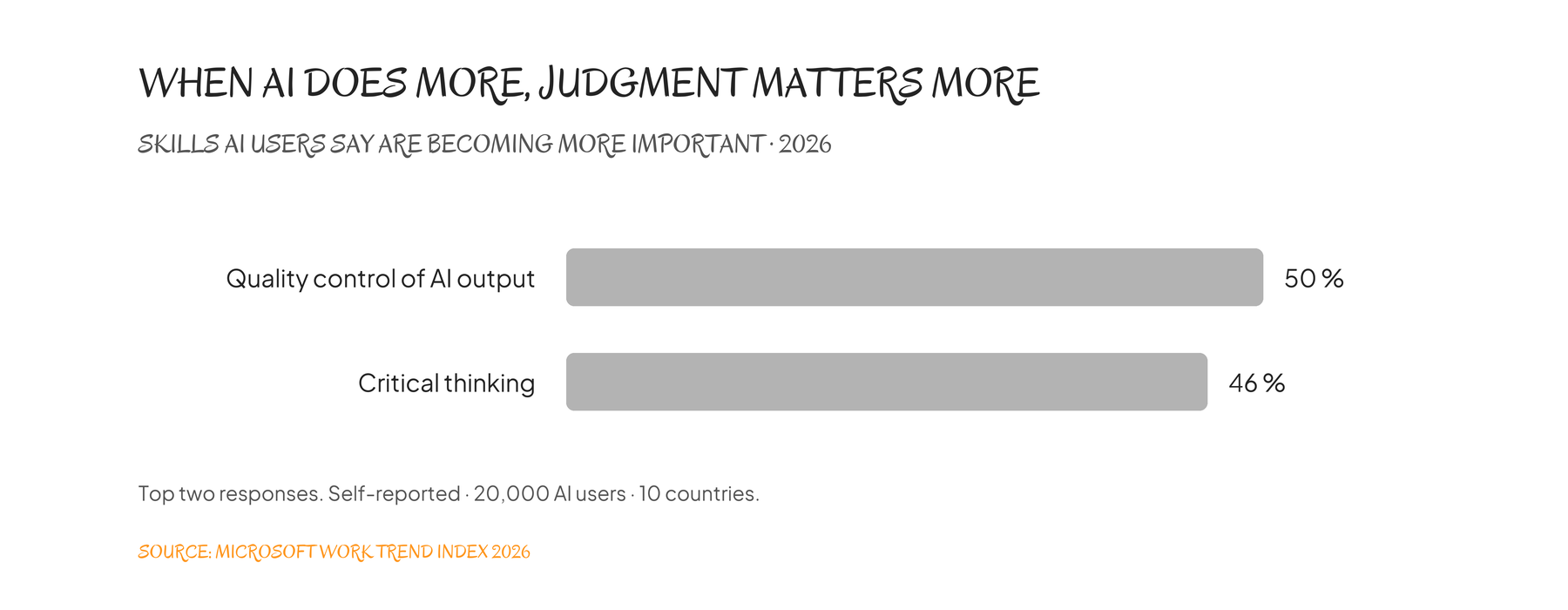
I think this will be one of the major changes in employees’ roles in the AI era. The emphasis shifts from execution to judgment. From carrying out the task to defining, assessing, and improving what a good result looks like.
Experience needs to become something we can explain
As AI agents take on more tasks, an important question is who can set the conditions for their work.
What does a good email response look like in our company? What does a communication need to achieve? What trade-offs should shape a proposal? When should a case be handed over to a human?
There is rarely one answer that works for every business. What counts as good depends on the industry, business model, customer relationship, and situation. That makes people with a deep understanding of the business essential.
At the same time, being good at doing the task yourself is not enough. Knowing how to do something and knowing how to explain it to someone else are two different skills.
An experienced employee might immediately recognise that a response to a customer is inappropriate. The next step is being able to explain why. Is the tone too formal? Is a clear answer missing? Are we promising something we cannot deliver? Has the response missed what the customer is actually asking?
Only when we can articulate the difference can our judgment become useful guidance for an agent.
Defining good is an ongoing task
An instruction such as “write a professional and helpful response” leaves many questions unanswered.
What does professional mean in our business? How much should we explain? What promises are we allowed to make? When should we ask a follow-up question?
A useful definition of good therefore needs both principles and concrete examples. It needs to describe the outcome we want, the boundaries we need to work within, and the trade-offs that matter.
For a customer response, that might mean making sure the recipient understands what happens next, who is responsible, and when they can expect an answer. Tone is part of quality, but the practical usefulness of the response matters just as much.
That definition then needs to be tested in practice.
When an agent produces a weak result, it may have misunderstood the instructions. But the result may also reveal that we were not clear enough ourselves. Perhaps we described the typical case and forgot the exceptions. Perhaps people in the organisation have different views on what the right approach should be.
The employee’s role then becomes assessing the result, understanding what went wrong, and improving the conditions for the next attempt.
Someone also needs to be available when the agent encounters a situation the instructions do not cover. Not every judgment can be set out in advance.

The employee as a tastemaker
I can see more employees taking on the role of tastemakers. People who can recognise quality, explain why something meets the standard, and develop that judgment over time.
This calls for knowledge of the business, an understanding of the recipient, and the ability to weigh competing priorities. What should we prioritise when speed and accuracy pull in different directions? When should we adapt to the customer, and when should we stick to a shared way of working?
These skills can be developed.
One practical approach is to ask employees to compare several results from the same task. Which is best? Why? What would need to change to make a weaker result useful?
When people have to explain their judgments, tacit knowledge becomes visible. Differences in perspective surface and can be discussed. That creates a stronger basis for instructions and a shared understanding of quality.
For business leaders, this also has implications for hiring. The ability to deliver good work yourself needs to be complemented by the ability to help others do good work. Explaining a way of working, articulating quality standards, and giving useful feedback become more important parts of the skill set.
Use the time freed up to understand quality
When people spend less time carrying out each individual task, there is an opportunity to spend more time on a question that is otherwise easily overlooked: How do we actually know that this is good?
That work benefits from bringing together people with different perspectives.
The person responsible for sales can assess whether a proposal helps the customer make a decision. The person responsible for delivery can see whether the promises are realistic. The person who deals with the customer afterwards knows which phrases tend to create misunderstandings.
Together, they can develop a more useful definition than any one of them could have produced alone.
But even a group of experienced people needs to test its assumptions against what recipients actually value.
This is where data becomes valuable. Which proposals have led to deals that also worked well during delivery? Which customer responses resolved the issue without several follow-up questions? Which internal communications helped employees understand and act?
The key is to choose indicators of success that reflect what you want to achieve. A quick sale, for example, is an incomplete measure if it is followed by misunderstandings and costly rework.
A larger set of previous results makes it possible to test our instincts and spot patterns that would otherwise be difficult to see.
Today’s definition also needs to hold up tomorrow
Past results can help us understand what has worked. But they cannot tell us everything about what will count as good in the future.
Customer expectations may change. New offerings may require different ways of working. What once felt fast and personal may eventually become a basic expectation.
That means someone also needs to look ahead. Which expectations do we think will rise? Which parts of our offering need to develop? What do we want customers to value us for in the future?
These judgments will need to be tested and adjusted. But if no one takes responsibility for them, agents risk becoming ever better at repeating a way of working that the business is outgrowing.
Clear quality standards create the conditions for scale
For business leaders, I would start with a recurring task where quality can be assessed. Bring experienced employees together, compare previous results, and articulate what makes a difference. Then use the agent’s work as input for improving the instructions.
Give someone responsibility for keeping the definition up to date and handling situations that require human judgment. Make sure the group also has access to data on how the results are received and how well they work in practice.
When the business’s knowledge becomes clear enough for agents to act on, it can be applied on a much larger scale. More customers, cases, or proposals do not then have to require a corresponding increase in manual work.
That depends on instructions that work, quality that is monitored, and exceptions that are caught. Otherwise, unclear expectations become a problem that grows with volume.
The ability to define good therefore becomes an important part of a company’s capacity to grow. Employees’ experience has a greater reach when it can guide work far beyond the tasks they have time to carry out themselves.