A customer gets in touch with a question. An employee finds the information, works out what the customer needs, and responds.
How much of that work should technology handle?
Finding the right information may be possible to automate. Suggesting a response too. But if the customer is unhappy and needs to talk to someone, the human conversation may be the most important part.
To me, that balance is what digitalisation is about. What should people do, and what can we let technology handle?
I tend to think about it in four steps. They describe how much of the work and the decisions we hand over to technology. AI can be part of the solution, but the same thinking applies to everyday business systems and other digital tools.
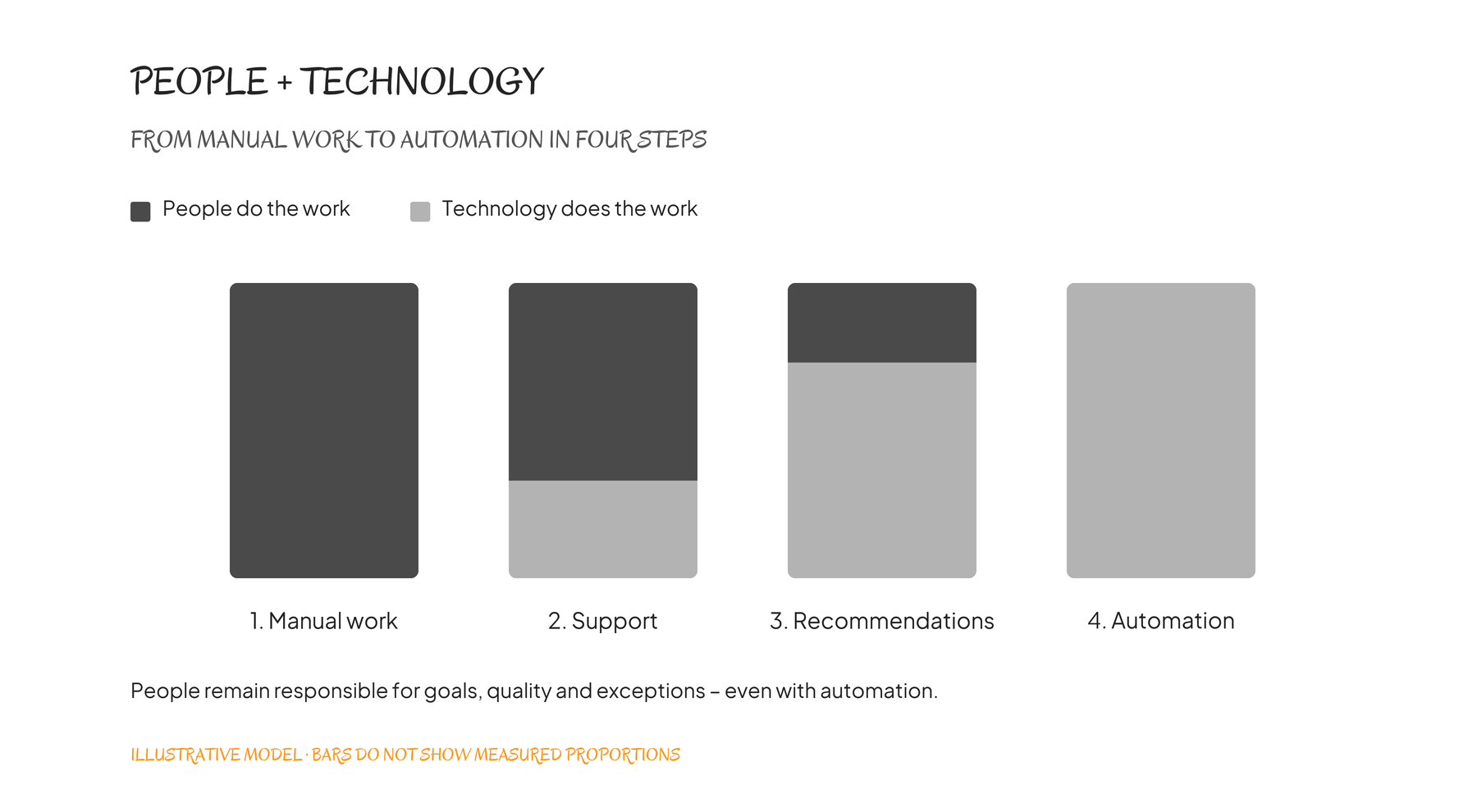
1. People do the work
In the first step, people carry out the task and make the decisions.
The employee receives the customer’s question, finds the information, chooses a solution, and responds. Digital tools may be available, but the person drives the work forward.
Before you try to automate the task, you need to understand how it works.
What information is needed? What takes time? What judgments does the employee make? When does someone need to make an exception?
A task that looks simple can draw on a lot of experience. An employee may know which customers need an extra explanation, or when a question is really about something else.
That knowledge needs to be made clear before technology can take on more.
2. Technology lends a hand
In the second step, technology helps people with parts of the work.
A system can bring the customer’s details together in one place, calculate a price, or remind someone to follow up on a case. AI can summarise previous contact or write a first draft.
The employee still decides what needs to happen and makes sure it gets done.
This can often make everyday work easier without handing over the decision itself. Less time goes into finding, copying, and putting together information.
It also becomes clearer what needs to improve. Are details missing? Is the information out of date? Does the employee have to correct the same mistakes every time?
These issues need to be resolved before technology takes on more responsibility.
3. Technology suggests, people decide
In the third step, the system suggests what you should do.
It might suggest a purchase when stock is running low, propose a delivery plan, or recommend how to resolve a customer issue.
A person reviews the suggestion and makes the decision.
For this to work, the employee needs to understand what the suggestion is based on. What information was used? Is there anything the system does not know?
Otherwise, it becomes difficult to judge whether the suggestion is good. There is also a risk that the employee approves it out of habit, even though the intention was for a person to make their own assessment.
This step works well when technology can do much of the preparation, but a person is still needed to consider the situation.
4. Technology carries out the work
In the fourth step, the system can carry out a clearly defined task without a person approving it every time.
An order can be placed when stock reaches a set level. A booking confirmation can be sent straight away. A routine customer question can be answered automatically.
For this to work, it needs to be clear what the system is allowed to do and when a person should take over.
What happens if the information is wrong? If the customer asks for an exception? Or if the situation is different from the usual one?
Someone also needs to review the results and change the way things work when circumstances change.
Fully automating a task means technology handles the day-to-day work. The company still needs to take responsibility for making sure it works.
When is it worth moving up?
I would start with tasks that come up often, or that you expect to become more common.
If you need to handle more customers, orders, or enquiries, automation can make room for growth without the manual work increasing at the same rate.
It can also be valuable when speed really matters. A customer may need an immediate answer, help in their own language, or service when the office is closed.
But before you hand over more, you need to know what a good result looks like and be able to check that you are getting it.
Different parts of a process can therefore sit at different steps. The system can gather information and suggest a solution, while the employee has the conversation with the customer.
You do not need to choose the same level for the whole job.
When is it better to stay where you are?
If you cannot describe what you want to achieve, it makes sense to wait before automating more.
It is difficult to build a good way of working if people in the business have different views on what the result should be. You first need to agree on what matters and which rules should apply.
Staying where you are can also be the right choice because human involvement creates value you want to keep.
A customer who has lost trust in the company may need to speak to someone who listens and takes responsibility. A fast, automatic response will not necessarily solve that problem.
Technology can still help in the background. It can bring up the history and make sure the right information is available for the conversation.
Sometimes you also need to take a step back. If employees spend a lot of time checking and correcting results, it may be better to let technology do a smaller part of the job until it works well enough.
Two things need to be in place
The first is a clear picture of what good looks like.
What does the customer need help with? How quickly does it need to happen? Which mistakes must not occur? When should a person get involved?
Concrete examples help. Compare some good and bad results and discuss the differences. This makes it easier to describe what the technology needs to be able to do.
The second is the right information.
The system needs access to the information required to do the job. It needs to be up to date and usable.
If the information is missing, you need to understand the cost of gathering it and keeping it current. Otherwise, a solution that saves time in one step may create more work somewhere else.
So start with two questions: Do we know what a good result looks like? And do we have the information we need to get there?
What will you do with the time you free up?
It is easy to focus on how much time can be saved. I think the next question is just as important: What will you use that time for?
Will you help more customers? Offer a more personal service? Solve more of the customer’s problems? Or reduce costs and perhaps prices?
The answer affects what you should automate.
If you want to build stronger customer relationships, the time you free up needs to go into work that strengthens those relationships. If you want to grow, you need to simplify the tasks that would otherwise limit how much you can deliver.
Start with a recurring task. Describe what a good result looks like and let technology handle a clearly defined part. Then review both the quality and how much work is actually left for people to do.
Move forward when it works and when the next step creates clear value.
The best balance may be full automation in one part of the business and plenty of human contact in another. What matters is making a deliberate choice, based on what customers need and what you want to achieve.